When you start with chess, moves like Nf3, exd5 or O-O can look like a secret code. In fact it is a very orderly system, called algebraic notation, used to write and read any game. It is the language of books, websites, videos and tournaments. This guide teaches it step by step, with tables and examples, and at the end you will be able to follow a complete game on a board. It will also help you understand any chess article you read next.
Step 1. The names of the squares. Every square on the board has a name made of a letter and a number. The letters a to h are the columns, called files, and they run from left to right as seen by the player with the White pieces. The numbers 1 to 8 are the rows, called ranks, and they are counted from White's side up to Black's. To name a square, say the letter first and then the number: e4 is the square where file e meets rank 4. The names are always the same, whether you play White or Black. For example, a1 is the dark corner at the bottom left from White's side.
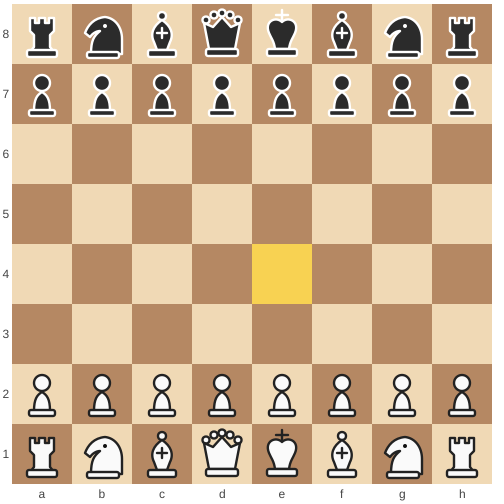
Step 2. The pieces and their letters. Each piece is written with a capital letter, except the pawn, which has none. In English the letters are K for king, Q for queen, R for rook, B for bishop and N for knight. The first table shows the pieces with their letter and a sample move, and the second compares five languages. A very common source of confusion: in Spanish, French and Italian the letter R is the king, while in English R is the rook and the king is K. In German the knight is S (Springer). That is why you should check which language a game is written in before you read its letters.
| Piece | Letter | Example |
|---|---|---|
| King | K | Kg1 |
| Queen | Q | Qd1 |
| Rook | R | Re1 |
| Bishop | B | Bc4 |
| Knight | N | Nf3 |
| Pawn | none (no letter) | e4 |
| Piece | EN | ES | FR | IT | DE |
|---|---|---|---|---|---|
| King | K | R | R | R | K |
| Queen | Q | D | D | D | D |
| Rook | R | T | T | T | T |
| Bishop | B | A | F | A | L |
| Knight | N | C | C | C | S |
Step 3. How a move is written. A normal move is written with the piece letter and the square it goes to. Nf3 reads as knight to f3. The pawn has no letter, so e4 on its own means pawn to e4. Moves are numbered by turn: in 1.e4 e5, the 1 is the first turn, e4 is White's move and e5 is Black's reply. White always goes first. To read a move aloud, say the piece and then the square. The next table shows eight typical moves, how they are read and what happens on the board.
| Move | Read it as | What happens |
|---|---|---|
| e4 | pawn to e4 | A pawn goes to e4. |
| Nf3 | knight to f3 | The knight goes to f3. |
| Bxc6 | bishop takes c6 | The bishop captures on c6. |
| exd5 | e takes d5 | The pawn on the e-file captures on d5. |
| O-O | castles kingside | The king and a rook move together. |
| Nbd7 | knight b to d7 | The knight on the b-file goes to d7. |
| e8=Q+ | e8 queen, check | A pawn reaches e8, becomes a queen and gives check. |
| Rd8# | rook d8, mate | The rook goes to d8 and it is checkmate. |
Step 4. The special symbols. Besides the piece and the square, some moves carry a symbol that adds information. An x means a capture: Nxe5 means a knight captures on e5. You do not write which piece was captured, only where. When a pawn captures, the move starts with that pawn's file, as in exd5, and an en passant capture is written the same way, with the square where the pawn ends up. A + at the end means check and # means checkmate. O-O is castling kingside (short) and O-O-O is castling queenside (long). When a pawn reaches the last rank it promotes, written with = and the chosen piece, as in e8=Q. Some games also use ! for a good move, ? for a mistake and a final result. The table lists all these symbols.
| Symbol | Meaning | Example |
|---|---|---|
| x | capture | Nxe5 |
| + | check | Qh5+ |
| # | checkmate | Rd8# |
| O-O | kingside castling (short) | O-O |
| O-O-O | queenside castling (long) | O-O-O |
| = | pawn promotion | e8=Q |
| ! | good move | Nf3! |
| ? | mistake | Nf3? |
| 1-0 / 0-1 / ½-½ | White wins / Black wins / draw | 1-0 |
Step 5. When two pieces can go to the same square. Sometimes two identical pieces can move to the same square, and the notation must say which one moves. To do that, add one extra character after the piece letter. If both knights can go to d7, Nbd7 means the knight from the b-file moves. If the two pieces stand on the same file, use the rank number instead, as in R1e2, where the rook on the first rank goes to e2. Add this extra character only when it is needed.
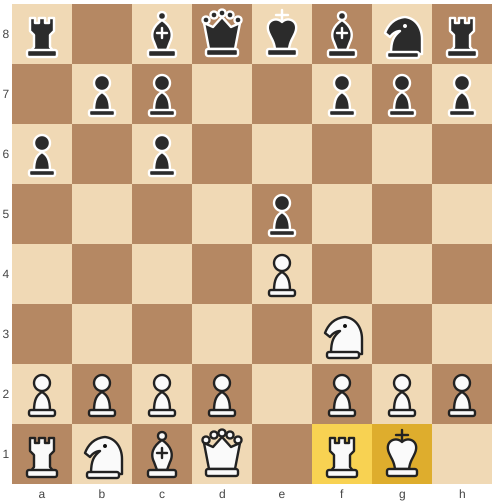
Step 6. Reading a full line. Now read this complete line: 1.e4 e5 2.Nf3 Nc6 3.Bb5 a6 4.Bxc6 dxc6 5.O-O. White opens with a pawn to e4 and Black answers with a pawn to e5. White develops the knight to f3 and Black develops a knight to c6. In move 3, the white bishop goes to b5 and Black plays a pawn to a6. In move 4, the bishop captures the knight on c6 and a black pawn recaptures from d7. In move 5, White castles kingside. The diagram shows the resulting position. Play this line on a board and compare it with what you just read.
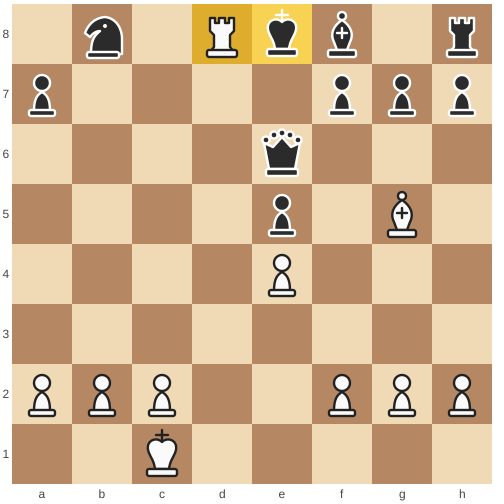
To practise: the Opera Game. It is a short and very famous game that Paul Morphy played in Paris in 1858, ideal for training your reading: 1.e4 e5 2.Nf3 d6 3.d4 Bg4 4.dxe5 Bxf3 5.Qxf3 dxe5 6.Bc4 Nf6 7.Qb3 Qe7 8.Nc3 c6 9.Bg5 b5 10.Nxb5 cxb5 11.Bxb5+ Nbd7 12.O-O-O Rd8 13.Rxd7 Rxd7 14.Rd1 Qe6 15.Bxd7+ Nxd7 16.Qb8+ Nxb8 17.Rd8#. Set it up on a board and go move by move. Look for the captures (x), the checks (+), the long castling in move 12 and the final checkmate (#). The diagram shows the last position, where the rook on d8 gives mate. If an old book shows moves such as bishop to queen's knight five, that is descriptive notation, which is no longer used. Today the standard is the algebraic notation you have just learned.
Summary. Every square is named with a letter (the file) and a number (the rank). Every piece is written with its letter, and the pawn has none. A move is the piece letter plus the destination square. An x is a capture, + is check, # is checkmate, and O-O and O-O-O are castling. And before you read a letter, check the language of the game.